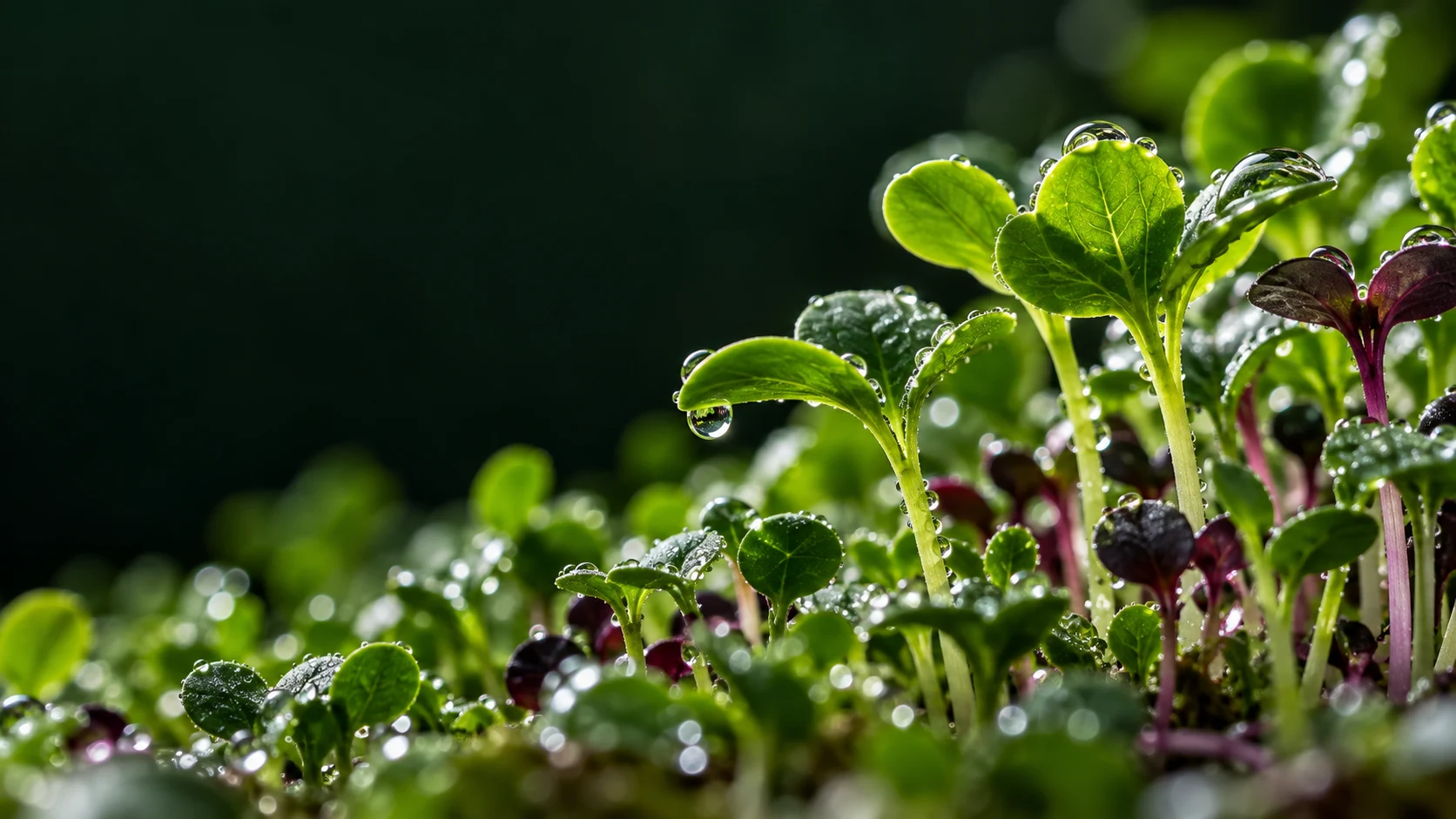
Follow crop-specific preparation directions. Larger seeds may benefit from soaking, while some small or gel-forming seeds are better sown without it. A cover is a temporary germination aid, not a reason to ignore a tray.
Some seeds need soaking; others can be sown dry. Covers and weights also depend on the crop and tray. Check each step against the directions for your seed before starting.
What soaking, covering and weighting do
| Step | Reason it may be used | What to check |
|---|---|---|
| Soaking | Hydrate certain seed before sowing | Whether this variety needs it, duration and drainage |
| Covering | Help retain surface moisture during establishment | When to remove it and how to inspect beneath it |
| Blackout | Exclude light for a specified establishment stage | The crop-specific endpoint rather than a fixed universal day |
| Weighting | Support contact or hull shedding in some systems | Whether the supplier recommends it and the appropriate load |
Which seeds need soaking?
University extension guidance treats seed preparation as species dependent. Peas and sunflower are examples where a soak may be recommended. Basil behaves differently when wetted. Use the packet’s instructions rather than averaging the timing from several unrelated crops.
Prepare only the amount you intend to sow. Use a clean container and suitable water, label the batch and drain as instructed. Keep to the specified soaking time.
When to remove the cover
Write down when the cover went on and when you checked it. Look for emergence, moisture distribution and abnormal growth. Remove the cover at the stage specified for that crop; do not keep an established crop covered simply because another grower’s calendar says three more days.
For your first attempt, a method with fewer moving parts is easier to understand. Only add weights, stacking or extended blackout when you have directions that suit the tray and crop.
Removing seed hulls
Some crops retain seed hulls as they emerge. Record whether hulls are scattered through the canopy or concentrated in a dry patch, then review the preparation method for the next sowing. Avoid pulling tightly attached hulls with enough force to tear the leaves.
Do not use repeated heavy misting as a universal hull-removal fix. If a crop has suspicious growth, slime or an unusual smell, stop and use the handling guidance rather than treating the problem as cosmetic.